Engineering task and calculation objective
This module sets up the hydraulic balance for vertical, tube-side heated evaporators (natural-circulation or thermosiphon reboilers) according to the VDI Heat Atlas (VDI-Wärmeatlas, the standard German reference work for heat transfer). In these units the circulation is driven not by a pump but by the density difference between the liquid column in the downcomer and the two-phase mixture in the heated tubes. The calculation determines the circulation mass flow that establishes itself from the equilibrium between the driving head and the pressure losses of the loop.
In process engineering, this hydraulic balance is the core of every thermosiphon reboiler design for distillation and rectification columns: only when circulation rate, vapor quality at the tube outlet, and heat transfer are consistent does the evaporator operate stably. Too little circulation leads to dryout and fouling in the tubes; an unfavorable liquid level leads to instabilities such as geysering or pulsations.
To this end, the module couples the two-phase pressure drop calculation with the boiling heat transfer calculation per the VDI Heat Atlas and supports various configurations of the vertical tube-side evaporator.
Standard and calculation basis: VDI-Wärmeatlas
Calculation workflow
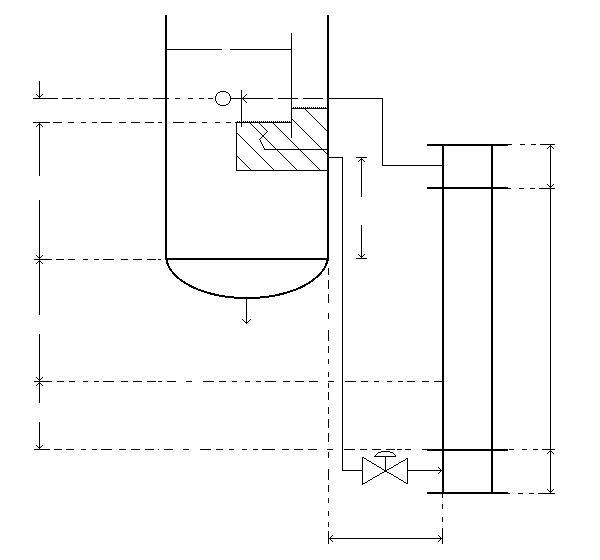
- Define the configuration and geometry: First, the evaporator configuration, tube dimensions, number of tubes, heated length, and the elevations of the liquid level and the return line are defined — they determine the driving head of the natural circulation.
- Determine the driving pressure difference: The liquid level in the separator or column sump gives the hydrostatic pressure at the tube inlet; opposed to it is the lower weight of the two-phase mixture column in the heated tubes. The difference is the driving pressure gradient of the circulation.
- Calculate the pressure losses of the loop: For an assumed circulation mass flow, the individual resistances are balanced: friction and fitting losses in the feed line, the single-phase heating zone, the two-phase friction pressure drop and the acceleration pressure drop in the evaporation zone, plus the losses of the vapor-liquid line back to the column.
- Iterate the circulation mass flow: The circulation mass flow is varied until the driving pressure difference and the sum of the pressure losses are in equilibrium. In parallel, the onset of boiling in the tubes is recalculated, since the heating zone depends on the mass flow.
- Check the operating point: At the converged operating point, the outlet vapor quality, heat transfer, and stability are assessed: the vapor quality at the tube outlet should lie in a robust range to avoid both dryout and unstable circulation.
Input quantities
| Quantity | Symbol | Unit |
|---|---|---|
| Distance of outer wall of column - outer wall of exchanger | S1 | m |
| Distance of vapour inlet nozzle - liquid surface | S3 | m |
| Distance of column end - liquid surface | S4 | m |
| Distance of column end - liquid outlet nozzle | S6 | m |
| Distance of exchanger end - tube sheet | Sh | m |
| Tube length | L | m |
| Inside diameter of tube | di | mm |
| Outside diameter of tube | da | mm |
| Number of tubes | n | - |
| Liquid outlet nozzle of column | WKA | - |
| Liquid outlet nozzle of exchanger | WTE | - |
| Tube bends and tees | WB1 | - |
| Valves | WV1 | - |
| Sum of friction factors | W1 | - |
| Vapour inlet nozzle of column | WKE | - |
| Vapour inlet nozzle of exchanger | WTA | - |
| Tube bends and tees in vertical part | WB2v | - |
| Valves in vertical part | WV2v | - |
| Sum of friction factors vertical | W2v | - |
| Tube bends and tees in horizontal part | WB2h | - |
| Valves in horizontal part | WV2h | - |
| Sum of friction factors horizontal | W2h | - |
| Inlet temperature of evaporating medium | Tin | °C |
| Dynamic viscosity of vapour | ηD | kg/(m·s) |
Calculation options
Type
-Nozzle at column inlet- · - Nozzle at column inlet / vaccum or inclination of vapour pressure curve > 0.013°C/kPa - · - Perforated tube at column inlet - · - Perforated tube at column inlet / vacuum or inclination of vapour pressure curve > 0.013°C/kPa -
Frequently asked questions
Why is the outlet vapor quality so important for a thermosiphon reboiler?
The vapor quality at the tube outlet is the central control variable: at too high a vapor quality, the liquid film in the upper tube sections dries out (dryout), the heat transfer collapses, and fouling increases. At very low vapor quality, the driving density difference is small and the circulation becomes sluggish. In practice, designs commonly target moderate outlet vapor qualities in the range of about 10 to 30%, depending on the fluid system and pressure.
What role does the liquid level in the column sump play?
The level determines the driving head of the natural circulation. A level approximately at the height of the upper tubesheet is common; a significantly lower level reduces the circulation and shifts the onset of boiling downward, while too high a level can suppress evaporation. Since the level fluctuates in operation, the hydraulic balance should be checked for the design point and for limiting levels.
Why can a thermosiphon evaporator become unstable?
Natural-circulation systems can be prone to density-wave oscillations and geysering, especially under vacuum operation, with small driving heads, or with a large subcooled inlet zone: the onset of evaporation and the pressure drop then couple periodically. Remedies include a restriction orifice in the feed line, an adjusted level, or a modified tube geometry — the hydraulic balance provides the basis for this assessment.
Does the calculation also apply to forced-circulation evaporators?
The basic principle of the pressure drop balance remains the same, but in forced circulation the pump head replaces the density difference as the driving quantity; the circulation rate is then largely imposed. This module is tailored to natural circulation in vertical tube-side evaporators.