Engineering task and calculation objective
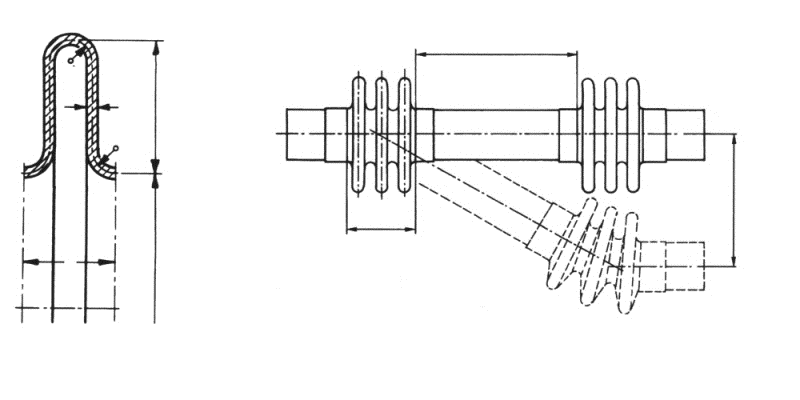
Bellows expansion joints absorb thermal expansion, installation tolerances and vibration in piping systems and apparatus without loading the connected components with high reaction forces. Their thin-walled, convoluted bellows is a deliberately flexible component: it must carry the internal pressure safely and at the same time endure the required deflections over the entire service life. Engineers who want to calculate a single-wall bellows expansion joint will find the verification scheme in AD 2000-Merkblatt B13 of the German AD 2000 pressure vessel code.
Module B13 designs single-wall bellows expansion joints: it verifies the pressure resistance of the bellows convolutions, determines the axial and angular (bending) spring rates of the bellows, and derives the allowable number of load cycles from the stress ranges of the deflection. The calculation options distinguish bellows with a circumferential weld from weld-free bellows in the cold-worked or normalized condition — the heat treatment condition considerably affects strength and fatigue behaviour.
In practice, the calculation is needed for the design of axial, lateral and angular expansion joints in piping engineering, for heat exchangers with an expansion joint in the shell, and for re-rating whenever the pressure, temperature or deflection of an existing plant changes.
Standard and calculation basis: AD 2000 B13: 2012-07
Calculation workflow
- Define the bellows geometry and execution: The inputs are the diameter, convolution height and pitch, wall thickness and number of plies of the bellows, together with the execution variant: with circumferential weld or weld-free, cold-worked or normalized. Collar rings and the knuckle regions at the bellows ends also enter the verification.
- Carry out the pressure resistance verification of the convolutions: For the internal pressure, the circumferential and meridional loadings of the convolutions are determined and compared with the allowable values of the bellows material in the respective condition. In addition, the stability of the bellows (column buckling/squirm under internal pressure) must be assessed.
- Calculate the spring rates: The axial and bending spring rates of the bellows follow from the convolution geometry. They are needed for the piping analysis, because the reaction forces of the expansion joint load anchors, nozzles and connected apparatus.
- Determine the stress range from the deflection: The required deflection — axial, lateral or angular — is converted into a stress range per load cycle. Cold-worked and normalized bellows are assessed differently in this step.
- Determine the allowable number of load cycles: From the stress range, the allowable number of load cycles follows via the fatigue curve. It is compared with the required number of cycles (e.g. start-up/shutdown operations over the service life); if it is insufficient, the number of convolutions, the ply construction or the distribution of the deflection must be adjusted.
Input quantities
| Quantity | Symbol | Unit |
|---|---|---|
| Type of expansion joint (1=single bellows, 2=double bellows) Type | Typ | – |
| Material type (1=austenitic, 2=ferritic) | WA | – |
| Internal/External pressure | pmax pmin | bar |
| Internal/External pressure | pmax pmin | bar |
| Axial movement, convolution | wmax wmin | mm |
| Axial movement, convolution | wmax wmin | mm |
| Bending angle of convolution | amax amin | ° |
| Bending angle of convolution | amax amin | ° |
| Equ. movement for angle (5) | wa,max wa,min | mm |
| Equ. movement for angle (5) | wa,max wa,min | mm |
| Torsional moment | MT,max MT,min | N·mm |
| Torsional moment | MT,max MT,min | N·mm |
| Unilateral axial movement | λ'max λ'min | mm |
| Unilateral axial movement | λ'max λ'min | mm |
| Eq. movement for lmax (8/11) | wl,max wl,min | mm |
| Eq. movement for lmax (8/11) | wl,max wl,min | mm |
| Design temperature | T | °C |
| Material designation | WNr | – |
| Modulus of elasticity for operating temperature | E | MPa |
| Strength value for operation | K | MPa |
| Joint efficiency factor | v | – |
| Safety factor for equivalent stress | Svp | – |
| Safety factor for circumferential stress | Sum | – |
| Load cycle safety (=5 without endurance proof) | SL (2,5) | – |
Frequently asked questions
Why is the number of load cycles so central for expansion joints?
The bellows deliberately operates in the range of high strains — locally sometimes above the yield strength. Its service life is therefore almost always fatigue-limited, not pressure-limited: a bellows that carries the pressure statically without any problem can show cracks in the convolution crests after a few thousand full strokes. The design therefore balances pressure resistance (thicker wall) against fatigue (thinner, more flexible wall, more convolutions or multi-ply construction).
What distinguishes cold-worked from normalized bellows?
During forming of the convolutions, the material work-hardens; if this condition is retained (cold-worked), the strength is higher but the ductility lower. Normalized (heat-treated) bellows have lower strength but more benign fatigue behaviour. AD 2000 B13 assesses both conditions with different characteristic values — stating the delivery condition is therefore mandatory information for any re-rating.
What is squirm and how is it avoided?
Squirm is the lateral buckling of a bellows under internal pressure — comparable to the buckling of a column: the bellows suddenly deflects sideways and is usually unusable afterwards. Squirm is promoted by high pressures, long lengths and poor guiding. Remedies are shorter bellows, guide pipes, hinged instead of axial expansion joints, and compliance with the stability limits of the code.
May an expansion joint absorb torsion?
Practically no. Twisting about the pipe axis generates shear stresses in the bellows that it can hardly tolerate structurally, and drastically reduces the squirm safety margin. The piping layout must keep torsion away from the expansion joint; where that is not possible, special designs or hinge combinations must be provided.