Engineering task and calculation objective
Cylindrical shells under external pressure do not fail by exceeding the tensile strength but by loss of stability: the shell buckles elastically or deforms plastically. Affected components include vacuum vessels, jacketed apparatus with heating or cooling jackets, the shell side of heat exchangers, and tubes under external pressure. If you want to calculate the allowable external pressure of a cylindrical shell, the governing rules of the German AD 2000 pressure vessel code are found in AD 2000-Merkblatt B6.
The B6 module determines the allowable external pressure against elastic instability and against plastic deformation. In the elastic verification, the critical number of circumferential buckling waves is sought and the smallest critical pressure is reduced by the safety factor for elastic instability; the plastic verification includes not only K/S but also the out-of-roundness of the shell. For tubes, the simplified calculation of the Merkblatt is included.
In addition, stiffening rings can be designed: they divide the shell into shorter buckling fields and thereby raise the allowable pressure considerably. Cylindrical shells with expansion joints or arbitrary stiffeners can also be handled — the effective buckling length between the stiffening elements is the central quantity.
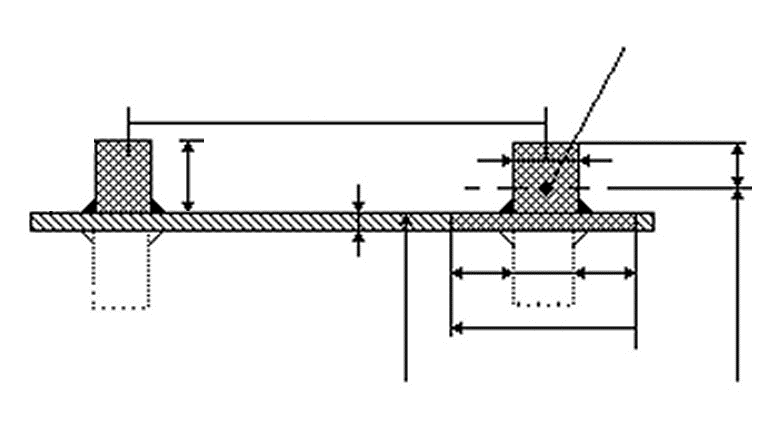
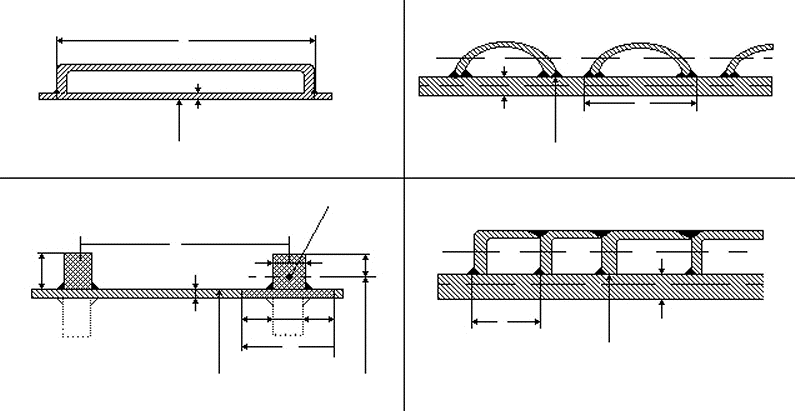
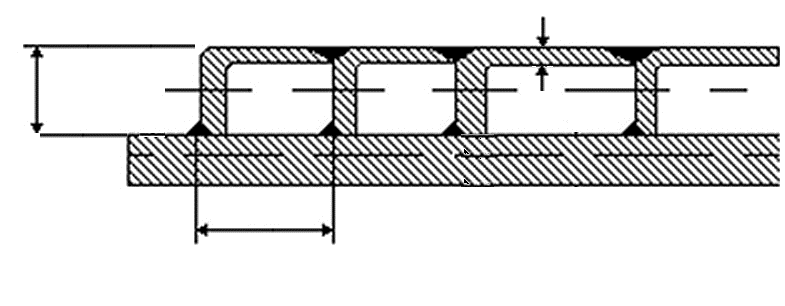
Standard and calculation basis: AD 2000 B6: 2020-01
Calculation scope
- Cylindrical shells with expansion joints under external pressure
- Cylindrical shells with stiffening rings under external pressure
- Cylindrical shells with arbitrary stiffeners under external pressure
- Tubes under external pressure
- Cylindrical shells under external pressure
Calculation workflow
- Define the geometry and stiffening concept: The inputs are the diameter, the wall thickness minus the allowances, and the unstiffened length between effective stiffeners (heads, flanges, stiffening rings, expansion joint ends). This buckling length largely governs the stability behavior.
- Verification against elastic instability: For the possible numbers of circumferential buckling waves, the critical elastic buckling pressure is calculated; the wave number with the smallest value governs. The allowable pressure results from division by the safety factor for elastic instability, using the modulus of elasticity at design temperature.
- Verification against plastic deformation: In parallel, the allowable pressure against plastic deformation is determined from the nominal design stress, the safety factor and the wall-thickness-to-diameter ratio; the fabrication-related out-of-roundness of the shell reduces the result. The smaller of the two allowable pressures governs.
- Simplified calculation for tubes: For tubes under external pressure — for example the tubes of a heat exchanger with a higher shell-side pressure — the module applies the simplified calculation of the Merkblatt, which requires no buckling-wave iteration.
- Dimension the stiffening rings: If the allowable pressure is insufficient, stiffening rings can be designed: the module determines the required moment of inertia of the ring including the effective shell width and checks the load-bearing capacity and spacing of the rings. The shell is then re-verified with the shortened buckling length.
Input quantities
| Quantity | Symbol | Unit |
|---|---|---|
| Final wall thickness | se | mm |
| Wall thickness manufacturing tolerance | c1 | mm |
| Corrosion / erosion allowance | c2 | mm |
| Outside diameter | Da | mm |
| Nominal design strength | K | N/mm² |
| Buckling length | l | mm |
| Out-of-roundness (see 7.3.4) | u | % |
| External calculation pressure | pav | bar |
| Modulus of elasticity | E | N/mm² |
| Inside diameter | Di | mm |
| Poisson's ratio | v | – |
| Material | Wk | – |
| Operating temperature | T | °C |
| Stiffening ring width | b | mm |
| Double run-out length | bm | mm |
| Effective shell length | lm | mm |
| Height | h | mm |
| Internally or externally placed stiffener | a=außen | – |
| Centre of gravity x-x distance to profile outer edge | e2 | mm |
| Load case | (Betrieb/Prüfung) | – |
| Pipe geometry: Nominal diameter | Nw | mm |
| Tolerance class for outside diameter acc. DIN EN ISO 1127 | 1127: | – |
| Safety factor *) | S | – |
| Safety factor *) | S | – |
Calculated results
| Quantity | Symbol | Unit |
|---|---|---|
| Allowable pressure (elastic instability) | p1 | bar |
| Allowable pressure (plastic deformation) | p2 | bar |
| Safety factor for elastic instability | Sk | – |
| Auxiliary value | Z | – |
| Number of circumferential waves | n | – |
| Diameter of centre of gravity | Dm | mm |
| Cross-sectional area | Am | mm² |
| Moment of inertia | Im | mm^4 |
| Section modulus | Wm | mm³ |
| Double run-out length | bm | mm |
| Effective shell length | lm | mm |
| Elastic buckling pressure of stiffener | pe | bar |
| Existing stress | (K=Ka = KV) δ | N/mm² |
| Centre of gravity x-x distance to profile outer edge | e2 | mm |
| Allowable stress | K/S | N/mm² |
| Conditions | Festigkeitsbedingung | – |
| Allowable pressure | (9) | – |
| Allowable pressure (unstiffened) | unversteiften | – |
| Allowable stress | (10) | – |
Calculation options
Internally or externally placed stiffener
external · internal
Load case
Operation · Testing
Tolerance class for outside diameter acc. DIN EN ISO 1127
None · 1 · 2 · 3 · 4
Shell with half pipe?
No · Yes
Frequently asked questions
Why are two separate verifications against instability and plastic deformation performed?
Thin-walled, long shells fail elastically by loss of stability well below the yield strength; thick-walled, short shells reach the plastic limit load first. Since it is not known in advance which mechanism governs, AD 2000 B6 requires both verifications — the smaller allowable pressure determines the design.
Which elements count as effective stiffening for the buckling length?
Dished heads, flanges, tubesheets and sufficiently stiff stiffening rings limit the buckling field; the buckling length is the distance between such elements. An expansion joint, however, does not stiffen — it extends the buckling field to the next effective stiffener, which is why shells with expansion joints must be considered separately.
What is the influence of the shell's out-of-roundness?
An out-of-round shell carries the external pressure with additional bending stresses, which lowers the allowable pressure against plastic deformation. AD 2000 B6 assumes a standard fabrication-related out-of-roundness by default; if the actual out-of-roundness exceeds the assumed value, the real value must be used in the calculation.
What does the number of critical buckling waves mean?
In elastic instability, the shell buckles into an integer number of waves around the circumference. Short, stiffened shells buckle with many waves, long unstiffened ones with few (a minimum of two). The module searches for the wave number with the smallest critical pressure — it serves as a plausibility indicator: if the buckling length changes, the critical wave number should change as well.