Engineering task and calculation objective
Spherical dished covers are shallow domed, removable closures: a spherical cap that is clamped onto the vessel end via a flange with gasket and bolts. They are used wherever a vessel or apparatus must be opened regularly — for example as covers of reactors, filters and heat exchangers. Engineers who want to calculate a spherical dished cover work to AD 2000-Merkblatt B4 of the German AD 2000 pressure vessel code, which covers the design types with their different flange executions.
Module B4 designs spherical dished covers for internal and external pressure and distinguishes three types: covers with the same wall thickness in spherical shell and flange, covers with a loose flange, and covers with a reinforced flange. In addition to the cap, the flange ring is verified, into which the bolt forces and the deviation force of the spherical shell are introduced. The gasket type and gasket material enter the bolt force determination via the gasket characteristics; clamp bolt executions are also supported.
The verification thus combines shell, flange and bolt calculation in a single component — making it correspondingly important for the design of removable apparatus covers and for re-rating whenever the gasket, pressure or temperature is changed.
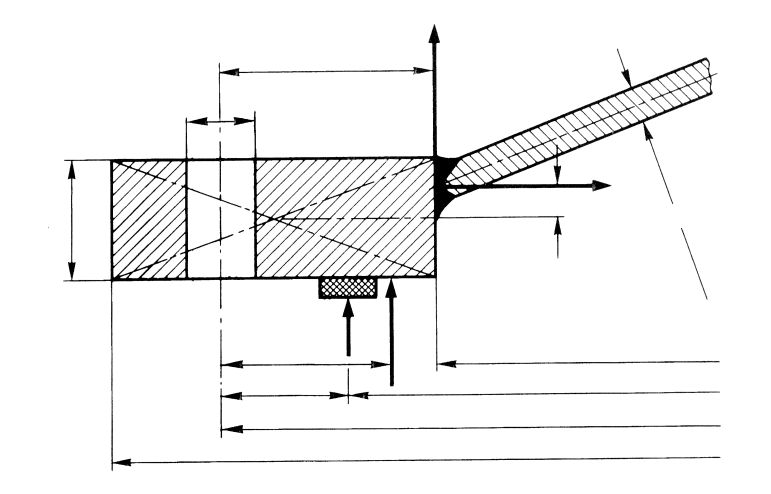
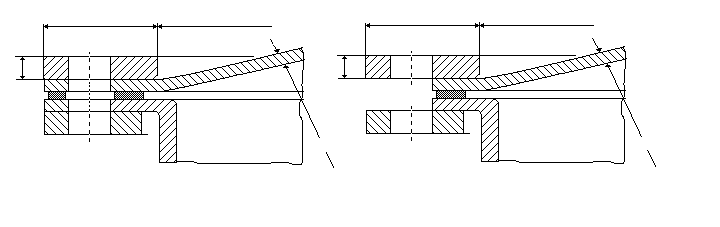
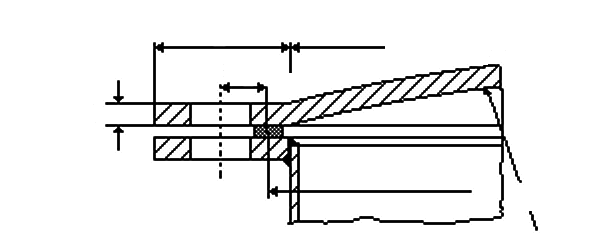
Standard and calculation basis: AD 2000 B4: 2000-10
Calculation workflow
- Define the design type and load case: First the design type is selected — same wall thickness in spherical shell and flange, loose flange or reinforced flange — together with the calculation direction (internal or external pressure) and whether clamp bolts are used.
- Record the geometry and the gasket: The inputs are the crown radius, diameters, flange dimensions, bolt circle and the gasket data. From the gasket material follow the characteristic values for seating (pre-deformation) and operating gasket load, which determine the required bolt forces in the assembly and operating conditions.
- Determine the bolt forces for assembly, operating and test conditions: For the governing conditions, the bolt forces are calculated from the pressure force on the cap, the gasket load requirement and, where applicable, the horizontal deviation component of the spherical shell; from these follows the required bolt size.
- Verify the spherical shell: The cap is verified as a spherical shell under internal or external pressure; for external pressure, the stability aspect (snap-through of the shallow cap) is added.
- Verify the flange ring: The flange is calculated for the moments from bolt force, gasket load and shell deviation force — depending on the design type as an integral, loose or reinforced ring. The result is the required flange dimensions or the stress verification of the selected cross-section.
Input quantities
| Quantity | Symbol | Unit |
|---|---|---|
| Type | Bauart | – |
| Calculation for | Drucks | – |
| Clamp bolts? | Klammerschrauben? | – |
| Type of gasket material | O-Ring | – |
| Type of gasket material | O-Ring | – |
Calculated results
| Quantity | Symbol | Unit |
|---|---|---|
| Inside diameter | di | mm |
| Final wall thickness | se | mm |
| Design pressure | p | bar |
| Design temperature | Η | °C |
| Material | Wk | – |
| Nominal design strength | K | N/mm² |
| Safety factor | S | – |
| Safety factor (elastic instability) | SK | – |
| Modulus of elasticity | E | N/mm² |
| Wall thickness manufacturing tolerance | c1 | mm |
| Corrosion / erosion allowance | c2 | mm |
| Crown radius | R | mm |
| Joint efficiency | v | – |
| Required wall thickness in the region of the run-out length | s | mm |
| Shape factor | β | – |
| Shape factor | β1 | – |
| Shape factor | CA | – |
| Shape factor | CB | – |
| Mean gasket diameter | dD | mm |
| Moment arm | aD | mm |
| Flange width | b | mm |
| Run-out length | X | mm |
| Shape factor | β2 | – |
| Shape factor | CC | – |
Calculation options
Type
Equal wall thickness (full-face gasket) · Equal wall thickness (gasket inside bolt circle) · Loose type flange (full-face gasket) · Loose type flange (gasket inside bolt circle) · Reinforced flange (rough joint) · Reinforced flange (smooth joint)
Calculation for
Internal pressure · External pressure
Clamp bolts?
With clamp bolts · Without clamp bolts
Type of gasket material
Soft · Metal-jacketed soft · Metal · O-Ring
Type of gasket material
Soft · Metal-jacketed soft · Metal
Frequently asked questions
When does one choose a spherical dished cover with a loose flange?
The loose flange bears on the cap only via a lip or flared edge and can rotate independently of it. This makes aligning the bolt holes easier and allows a different (cheaper) material to be used for the flange than for the wetted shell part — for example a stainless steel cap with a flange ring of unalloyed steel. The disadvantages are the additional joint and the somewhat softer connection.
Why does a horizontal force component arise at the spherical dished cover?
The shallow spherical shell carries the pressure via membrane forces that act obliquely on the flange ring. Besides the axial component taken by the bolts, a radial deviation component arises that tries to expand or contract the flange ring. The shallower the cap, the greater this ring loading — it is an essential difference from the flat cover plate and is what makes the flange verification to B4 necessary.
What influence does the gasket material have on the design?
The gasket characteristics determine which surface pressure is needed for seating during bolt-up and which residual pressure is needed in operation. Soft gaskets require lower forces but limit pressure and temperature; grooved metal or fully metallic gaskets require considerably higher bolt forces, which flange and bolts must carry. Changing the gasket on an existing cover therefore requires a recalculation.
What must be considered with clamp bolts?
Clamp or hook bolt connections do not engage through holes but grip the flange rim via clamps. This allows quick opening but changes the load introduction: the clamp seat loads the flange rim locally, and the effective lever arms in the flange moment shift. The module accounts for this execution via the corresponding option.