Engineering task and calculation objective
The RING module performs the strength verification of jacket closures on vessels according to TGL 32903/22 (issue 1983-11), a standard of the former East German TGL code. It calculates easy-to-fabricate ring and cone closures that connect the jacket to the vessel shell — in the variants U-shaped jacket with ring closure (figures 6a–6d), U-shaped jacket with cone closure (figures 5a–5d), and cylindrical jacket with ring or cone closure.
Having to calculate jacket closures is everyday work in the fabrication of stirred and process vessels: the heating or cooling jacket is under its own design pressure, and the closure ring or cone must transfer the pressure and edge forces between the vessel wall and the jacket. To this end, the module determines the allowable stresses from the design gauge pressure, material properties with safety factors for operation and testing, allowances for corrosion and wall thickness undertolerance, and weld joint efficiencies, and verifies the as-built width and height of the closure ring via dimensionless quantities (relative pressure, geometric ring parameter, relative loading moment).
TGL 32903/22 is a code of the former GDR and has been withdrawn; it remains relevant for the re-rating of existing equipment and as a proven calculation method for these special closure geometries, which are hardly treated explicitly in Western codes. For new designs, its integration into the applicable code (e.g. AD 2000 or EN 13445) must be agreed with the authorized inspector.
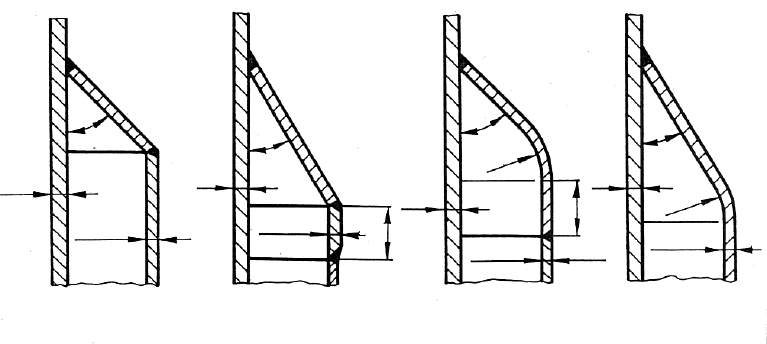
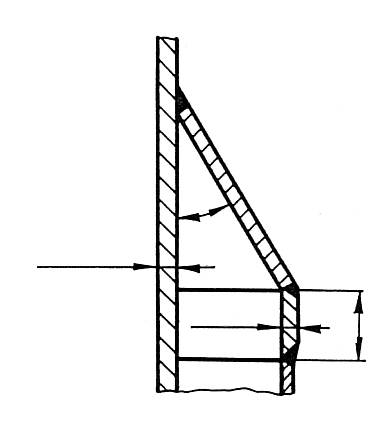
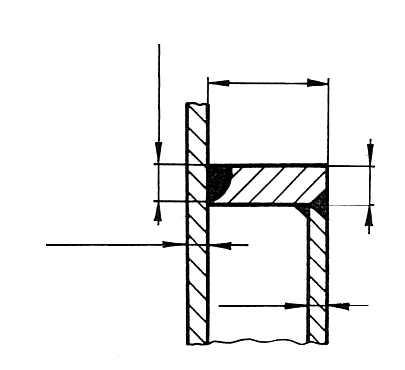
Standard and calculation basis: TGL 32903/22: 1983-11
Calculation workflow
- Select configuration and geometry: The jacket shape (U-shaped or cylindrical) and the closure type (ring or cone) are chosen according to the figures of the TGL, together with the dimensions: as-built width and height of the closure ring and the diameter ratios of vessel and jacket.
- Define load cases and pressures: For operation and testing, the design gauge pressure or absolute design pressure of the jacket space is applied; both load cases are verified separately with their respective safety factors.
- Material properties and allowable stresses: For the closure ring, jacket and vessel wall, the materials are entered with their strength values at design temperature; division by the safety factors for operation and testing yields the allowable stresses of the components.
- Allowances and weld joint efficiency: The corrosion allowance and wall thickness undertolerance are combined into the total allowance for each component; the joint efficiencies of the circumferential and radial welds enter the load-bearing capacity of the connection as a calculated efficiency.
- Verification via dimensionless quantities: From the relative pressure, geometric ring parameter and relative loading moment, the loading of the closure ring is determined and compared with the allowable stress; in addition, the weld throat thickness and the relative ring height are checked against the requirements of the TGL.
Input quantities
| Quantity | Symbol | Unit |
|---|---|---|
| Temperature | T | °C |
| Absolute design pressure | p1a p2a | bar |
| Absolute design pressure | p1a p2a | bar |
| Design pressure | p1 p2 | MPa(p) |
| Design pressure | p1 p2 | MPa(p) |
| Inside diameter | D1 D2 | mm |
| Inside diameter | D1 D2 | mm |
| Diameter ratio | D2/D1 | – |
| Connection angle | α | ° |
| Material | Nr | – |
| Final wall thickness | s1 s2 | mm |
| Final wall thickness | s1 s2 | mm |
| Wall thickness ratio | s2/s1 | – |
| Ratio | s1/D1 | – |
| Ratio | s2/D2 | – |
| Final height of ring joint | h0 | mm |
| Allowable pressure in jacket | [p2] | MPa(p) |
| Allowable stress of ring joint | σ0 | N/mm² |
| Allowable stresses | σ1 | N/mm² |
| Allowable stresses | σ2 | N/mm² |
| Total allowances | cM cM | mm |
| Reference ring height | H | mm |
| Weld quality circumferential weld (vessel) | φT1 | – |
| Weld quality circumferential weld (jacket) | φT2 | – |
Calculated results
| Quantity | Symbol | Unit |
|---|---|---|
| (36) | ≤ | – |
| (36) | ≤ | – |
Calculation options
Joint according to fig.
1 · 2
Frequently asked questions
May I still design new equipment to TGL 32903/22?
The TGL standards were withdrawn with German reunification and are not harmonized codes in the sense of the Pressure Equipment Directive. For new equipment, the TGL calculation serves as a proven, physically sound method whose application as an 'other recognized code' must be agreed with the notified body or authorized inspector. For the re-rating and assessment of existing equipment from GDR production, it is the original and appropriate code.
How do ring and cone closures differ in practice?
The ring closure connects jacket and vessel wall via a flat annular cross-section — easy to fabricate, but subjected to bending, which is why the width and height of the ring must be verified. The cone closure transitions the jacket into the vessel wall via a conical transition piece; it introduces the forces in a more membrane-like manner but requires forming work or conical fabrication. The TGL covers both forms for U-shaped and cylindrical jackets alike.
Why is the test condition verified separately?
During the pressure test, the test pressure acts at ambient temperature, but with a reduced safety factor against the yield strength at room temperature. Depending on the material and design temperature, the test condition can govern the design despite the milder safety factors — particularly when the jacket space is pressure-tested alone or against the evacuated interior. That is why the module performs both verifications with their own safety factors.
What role does the weld joint efficiency play at the closure ring?
The closure welds transfer the entire jacket forces into the vessel wall. The joint efficiency rates the weld type and extent of examination; the calculated efficiency reduces the usable load-bearing capacity accordingly. In addition, the as-built weld throat thickness must be verified — an undersized fillet weld at the ring is a typical weak point of such designs.