Engineering task and calculation objective
The KAP11 module calculates isolated openings in flat boiler end plates to Chapter 11 of DIN EN 12953-3:2016, the design code for pressure parts of shell boilers. Flat end plates of smoke-tube and three-pass boilers are regularly pierced by openings, for example for manholes, handholes, inspection openings or nozzle connections. Every opening weakens the end plate and must be verified according to the rules of the standard.
Unlike a cylindrical shell, a flat end plate carries the pressure predominantly in bending; an opening therefore changes the stress distribution in the plate panel considerably. DIN EN 12953-3 provides rules for assessing isolated openings, i.e. openings that do not interact with one another: based on the location of the opening in the stayed or unstayed plate region, its dimensions and the type of reinforcement, for example welded-on rings, welded-in nozzles or a locally increased plate thickness.
Anyone who wants to calculate an opening in a flat boiler end plate obtains from the module the complete verification to DIN EN 12953-3, including the geometric limits of validity, as required for manufacturing and for the assessment by the notified body or the approved inspection body.
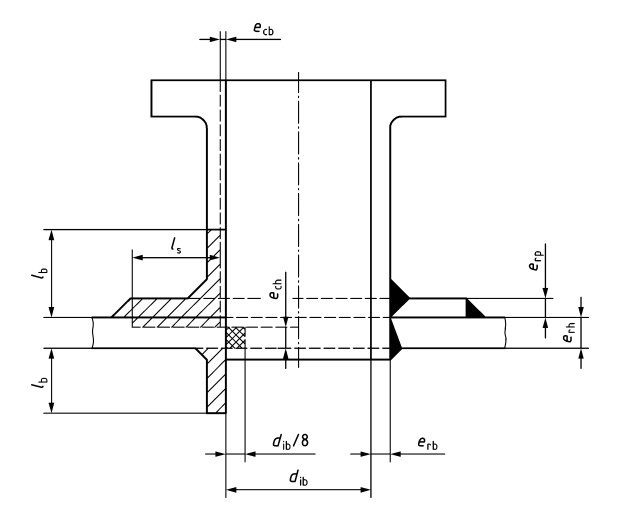
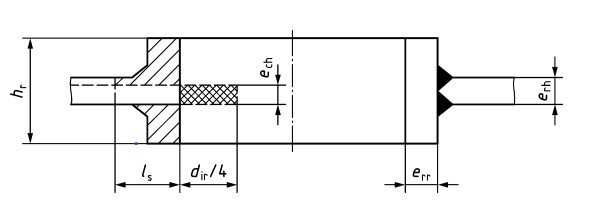
Calculation workflow
- Record end plate geometry and staying: First the data of the flat end plate are entered: plate thickness, governing panel dimensions and the type of support provided by stays such as smoke tubes, gusset stays or stay bolts, because these determine in which plate panel the opening is located and which verification rules apply.
- Define the opening: The isolated opening is described by shape, diameter and location. The standard assumes that the opening stands alone, i.e. that its distance to neighboring openings and edges is large enough that the disturbed stress zones do not overlap.
- Specify loading and material properties: The design pressure and design temperature are entered; from the end plate material follows the allowable design stress according to the strength rules of DIN EN 12953-3.
- Verify the reinforcement: The module checks whether the opening is permissible without additional measures or whether reinforcement is required, for example a welded-in nozzle, a reinforcing ring or a greater plate thickness, and verifies the load-bearing capacity in the weakened region.
- Check geometric limits: Finally, the limits of application of the chapter are checked, including permissible opening sizes and minimum spacings; only within these limits is the verification by the simplified method of the standard valid.
Input quantities
| Quantity | Symbol | Unit |
|---|---|---|
| Load case | – | – |
| Subjected to heat transfer | – | – |
| Gas entery temperature | tG | – |
| Nominal wall thickness | e | – |
| Heating by | – | – |
| Calculation pressure | pc | – |
| Saturation temperature | ts | – |
| Additional temperature | tz | – |
| Calculation temperature | tc | – |
| Type of opening | – | – |
| Reinforcement | – | – |
| Type of the Ellptical holes | – | – |
| flate plate | – | – |
| Material Strength | Kh | – |
| Yield Strength | RP0.2 | – |
| Safety Factor | Sh | – |
| Safety Factor | Shtest | – |
| Design Stress | fh | – |
| Minus tolerance | c1h | – |
| Corrosion Allawance | c2h | – |
| Branch opening or Revision Opening | – | – |
| Material Strength | KN | – |
| Yield Strength | RP0.2 | – |
| Safety Factor | SN | – |
Calculation options
Load case
operation · test
Subjected to heat transfer
Yes · No
Gas entery temperature
≤ 400 · 400-800 · > 800
Heating by
radiation · convection
Type of opening
Unreinforced opening · Branch opening · Revision Opening
Reinforcement
Yes · No
Type of the Ellptical holes
Manholes · Headholes · Handholes
Diameter availability
inside · outside
Frequently asked questions
What does isolated opening mean in the sense of the standard?
An isolated opening is a stand-alone opening whose disturbed stress zone does not overlap with that of a neighboring opening. If openings lie closer together, for example in the tube field of a tube plate, other rules apply, such as verifications using ligament efficiency factors for perforated fields. The distinction is made via the minimum spacings defined in the standard.
Why are openings in a flat end plate more critical than in a cylindrical shell?
As a plate, the flat end carries the pressure mainly in bending; the bending stresses are already high without any opening, which is why flat ends are thicker than dished ends. An opening interrupts the load-bearing plate at a location subject to bending and creates additional stress concentrations. The standard therefore requires dedicated verifications and often structural reinforcement.
Do manholes and handholes with closing covers also count as openings?
Yes. Closable openings such as manholes, headholes and handholes also weaken the end plate and are verified as openings. In addition, the design requirements of the boiler standards regarding minimum sizes and design of inspection openings apply to them; the strength verification of the opening does not replace these requirements.
Does this chapter also apply to openings in dished ends?
No. Chapter 11 of DIN EN 12953-3 deals with openings in flat boiler end plates. Openings in dished ends and openings in the cylindrical shell are verified according to other sections of the standard, in the shell for example according to Chapter 8 on openings and branches in cylindrical shells.