Engineering task and calculation objective
The KAP9 module calculates the ends of shell boilers to Chapter 9 of DIN EN 12953-3:2016. The chapter covers the closure ends of the boiler: dished ends of torispherical (Kloepper or Korbbogen) shape as well as the flat end plates typical of smoke-tube boilers, which may be unstayed or stayed by smoke tubes, stay tubes, gusset stays and stay bolts.
The load-bearing behavior of the two designs is fundamentally different: dished ends carry the pressure predominantly through membrane stresses and manage with comparatively small wall thicknesses, the knuckle being the governing location. Flat ends carry the load as a plate in bending; their required thickness depends decisively on the size of the free, unsupported plate panels, which is why the arrangement of the stays enters the calculation directly.
In practice, the module is needed for the design and re-rating of three-pass and smoke-tube boilers, to calculate the required end plate thickness to DIN EN 12953-3, to assess the plate panels between the stays, and to document the results for conformity assessment or periodic inspection.
Calculation workflow
- Define end shape and geometry: First the design type is selected: a dished end with crown and knuckle radius, or a flat end with its dimensions and edge connections. For the flat end, the location and type of the stays are also recorded, because they determine the governing plate panels.
- Enter loading and material: The design pressure and design temperature are specified; from the end material follows the allowable design stress including the safety factors of the standard. Allowances for corrosion and wall thickness tolerance are taken into account.
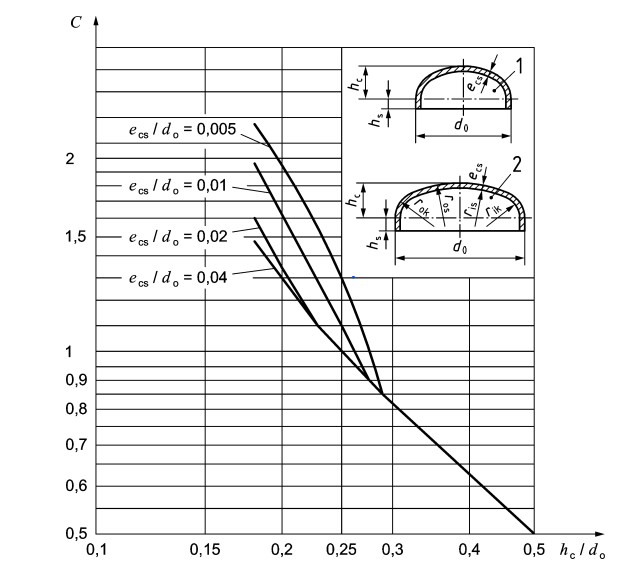
- Verify the dished end: For dished ends, the required wall thickness is determined from the code equations for the crown and the knuckle; the larger value governs. In addition, the geometric limits of the end shape are checked, such as permissible ratios of knuckle radius and straight flange height to diameter.
- Verify the flat end with its plate panels: For the flat end, the required thickness is determined for each plate panel between the stays using the calculation coefficients of the standard; the coefficient depends on panel shape and edge fixity. The largest panel, often in the unstayed edge region or between furnace tube and shell, yields the governing plate thickness.
- Pass on the stay loads: From the end plate verification follow the tensile forces that the stays and stay tubes must carry; these loads enter the verifications of the tubes and tube plates according to Chapter 12 and of the other staying elements.
Input quantities
| Quantity | Symbol | Unit |
|---|---|---|
| load case | – | – |
| Subjected to heat transfer | – | – |
| Gas entery temperature | tG | – |
| Nominal thickness | e | – |
| Heating by | – | – |
| Calculation pressure | pc | – |
| Saturation temperature | ts | – |
| Additional temperature | tz | – |
| Calculation temperature | tc | – |
| Type of pressure | – | – |
| Type of heads | – | – |
| Type of dished head | – | – |
| Type of closures | – | – |
| Area type | – | – |
| Type of plates | – | – |
| With additional bending moment | – | – |
| Nominal thickness | es | – |
| Allowance for metal wastage (for es) | – | – |
| Nominal outside diameter | do | – |
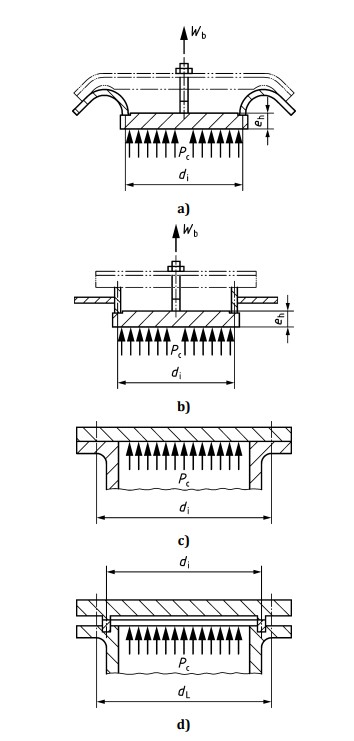
| Calculation diameter of the pressurized area (Fig.17) | di | – |
| Depth of curvature of dished head | hc | – |
| Inside corner radius of dished end or spherical shell | ris | – |
| Outside corner radius of dished end or spherical shell | ros | – |
| Inside radius of dishing of dished ends or of knuckle or relief groove of flat ends | rik | – |
Calculation options
load case
operation · test
Subjected to heat transfer
Yes · No
Gas entery temperature
≤ 400 · 400-800 · > 800
Heating by
radiation · convection
Type of pressure
External pressure · Internal pressure
Type of heads
Unstayed dished heads without openings · Flat unstayed removable closures
Type of dished head
torispherical head · Hemispherical head · Ellipsoidal heads
Type of closures
external-Fig.c · with bolting forces-Fig.d · internal doors-Fig.a.b
Frequently asked questions
Why are flat boiler ends so much thicker than dished ends of the same size?
A dished end carries the pressure largely through membrane tensile stresses in the shell, whereas a flat end carries it through plate bending. Bending uses the cross-section much less efficiently, so unstayed flat ends of large diameter would be uneconomically thick. In the smoke-tube boiler this is solved by staying: smoke tubes, stay tubes and gusset stays subdivide the end plate into small panels, so that moderate thicknesses are sufficient.
Which location governs for a dished end?
Usually the knuckle, i.e. the transition radius between the crown and the cylindrical straight flange. Membrane and bending stresses are superimposed there, which is why the standard provides a separate, usually governing wall thickness equation for the knuckle with a shape-dependent coefficient. Tight knuckle radii increase this coefficient and thus the required wall thickness.
What must be considered when arranging the stays?
The stays must be distributed so that no plate panel exceeds the size permissible for the chosen plate thickness; the critical zones are often the edge regions between the outermost tube row and the shell as well as the area around the furnace tube. In addition, the stays must carry the tensile forces resulting from the panels within the allowable stresses of the standard, and abrupt stiffness jumps should be avoided to limit additional bending in the end plate.
Does Chapter 9 also cover the openings in the end?
No. Chapter 9 provides the basic thickness of the unweakened end. Isolated openings in flat boiler end plates, such as manholes or nozzles, are verified separately according to Chapter 11 of DIN EN 12953-3; the perforated fields of the tube plates are dealt with in Chapter 12.