Engineering task and calculation objective
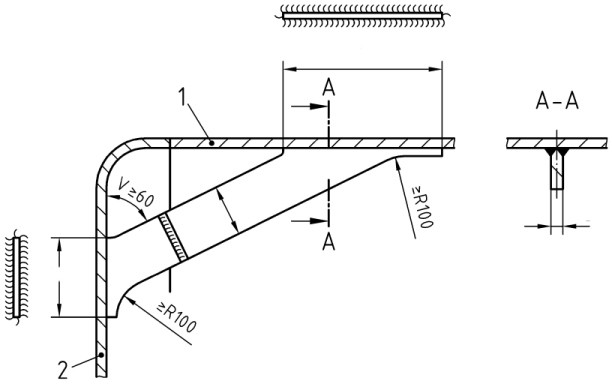
The ECKA module calculates corner stays (diagonal stays) of steam boilers — the inclined anchors that brace the edge region of flat ends of shell boilers, which is not supported by tubes or the furnace tube, against the boiler shell. The basis is the German agreement Vereinbarung Dampfkessel 003 (2011-01) together with a design proposal from the journal "Technische Überwachung" that aims at optimum stay cross-sections following the flow of stress.
From the load allotted to the stay and the allowable stress, the module determines the required corner-stay cross-section at mid-stay as well as the required weld attachment lengths at the shell-side and at the end-side connection. The required values are compared with the actual ones; in addition, the module reports the actual stress and checks whether the geometry conditions and stress limits are satisfied.
The corner-stay calculation is needed for the design and re-rating of shell boilers (fire-tube/smoke-tube boilers), for repairs to existing boilers and for periodic inspections whenever the staying of flat ends has to be verified.
Standard and calculation basis: Vereinbaung Dampfkessel 003 2011-01
Calculation workflow
- Determine the load on the stay: From the pressure and the supported area of the flat end assigned to the corner stay, the load that the stay must carry as a tensile force is obtained. This force is the central input quantity of the verification.
- Establish the allowable stress: The allowable stress follows from the stay material at the design temperature, taking into account the safety factors of the code; for inclined stays, the inclination relative to the normal of the end is taken into account.
- Determine the required cross-section: From the load and the allowable stress, the required corner-stay cross-section at mid-stay is obtained. Following the proposal in "Technische Überwachung", the stay widths at the end-side and shell-side connections are additionally graded so that the force flows without abrupt changes in cross-section.
- Verify the welded connections: For the shell-side and the end-side connection, the required weld attachment lengths are determined and compared with the actual lengths, so that the welds transmit the stay force safely.
- Evaluate the verifications: The module compares the actual and required cross-sections and weld lengths, reports the actual stress and indicates whether the geometry conditions are fulfilled and the stresses are within the allowable limits.
Input quantities
| Quantity | Symbol | Unit |
|---|---|---|
| Design pressure | p | bar |
| Design temperature | t | °C |
| Final anchor thickness | eg | mm |
| Material | WNr | – |
| Nominal design strength | K | N/mm² |
| Safety factor | S | – |
| Pressure loaded area | F | mm² |
| Angle of inclination | (≥ 60°) V | ° |
| Load | W | N |
| Allowable stress | f | N/mm² |
| Cross-sectional area (middle, actual) | Ag,act | mm² |
| Weld length, actual (shell-side) | lM, act | mm² |
| Weld length, actual (bottom) | lP,act | mm² |
| Cross-sectional area (middle, required) | eg, req | mm |
| Weld length, required (shell-side) | lM,req | mm |
| Weld length, required (bottom) | lP,req | mm |
| Arc length | Bogenlänge | mm |
| Geometric factor | fG | - |
| Milling allowance | c1 | - |
| Plate thickness | sP | - |
| Angle alpha | α | ° |
| Shell diameter | dM | – |
| Shell thickness | sM | mm |
| Actual stress | σ | N/mm² |
Frequently asked questions
Why does a boiler need corner stays at all?
Flat ends of shell boilers can carry the internal pressure in an unstayed condition only with uneconomically large wall thicknesses. The central region is supported by the smoke tubes and the furnace tube; the edge region between the tube field and the shell, however, remains unstiffened. This is exactly where the corner stays act, transferring the pressure load of this strip of the end diagonally into the cylindrical shell.
Why is the stay cross-section graded along its length?
At mid-stay practically pure tension acts; at the connections, bending components from the inclination and from the flexibility of end and shell are added. A stress-flow-oriented design with wider ends and a slimmer middle avoids notch effects and local overstressing at the welded connections — precisely this grading is reported by the module with the stay widths at mid-stay and at the end-side and shell-side connections.
What must be considered regarding the inclination of the corner stay?
The stay is inclined relative to the normal of the end and therefore carries load only with its component in the direction of the end loading. The flatter the stay lies, the larger the stay force and the required cross-section become for the same end load. In addition, the codes limit the permissible inclination and the edge distances; the geometry check of the module controls these conditions.