Engineering task and calculation objective
The FGB module calculates shallow dished ends under internal pressure. Shallow dished ends — flat spherical caps with a small crown height and a knuckle — are an economical alternative to Klöpper (torispherical) or Korbbogen (semi-ellipsoidal type) ends when equipment operates in the low pressure range and headroom or fabrication cost is limited, for example on unpressurized to slightly pressurized vessels, covers and equipment housings.
The common pressure vessel codes do not cover this geometry: neither the German AD 2000 code nor the ASME Code contains calculation rules for shallow dished ends outside the standardized head shapes. The strength verification is therefore carried out according to the technical literature — S. Schwaigerer, "Festigkeitsberechnung im Dampfkessel-, Behälter- und Rohrleitungsbau", and J. F. Harvey, "Theory and Design of Pressure Vessels". The module implements these verification concepts and thus makes this special geometry calculable and documentable.
The character of the verification should be noted: with a shallow crown, considerable bending and edge discontinuity stresses arise at the transition to the knuckle or to the cylinder in addition to the membrane stresses of the spherical cap; they dominate the load-carrying behaviour and restrict the application to the low pressure range.
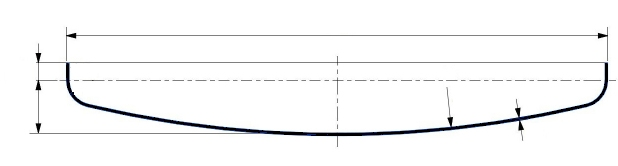
Standard and calculation basis: Harvey J., Theory and Design of Pressure Vessels and Schwaigerer S., Festigkeitsberechnung
Calculation workflow
- Define the geometry of the end: The crown radius of the spherical cap, the knuckle radius, the end diameter and the wall thickness describe the shallow dished end. The ratio of crown height to diameter determines how strongly the load-carrying behaviour deviates from that of a pure membrane shell.
- Apply loading and material properties: The internal pressure and the allowable stress of the material at the design temperature are specified; where applicable, allowances for corrosion and wall thickness undertolerance must be taken into account.
- Determine the membrane stresses of the spherical cap: For the spherical cap region, the membrane stresses are determined from pressure, crown radius and wall thickness. Because of the large crown radius of shallow ends, they come out higher than for more strongly dished standard heads of the same nominal diameter.
- Verify edge discontinuity and bending stresses at the transition: At the transition cap–knuckle–cylinder, bending and edge discontinuity stresses arise, which are captured with the approaches of Schwaigerer and Harvey. The superposition of membrane and bending components is checked against the allowable values of the chosen verification concept.
- Evaluate the result: The actual wall thickness is compared with the required one, or the stress utilization is reported. If the loading in the knuckle region is too high, larger knuckle radii, a greater wall thickness or a deeper crown are the usual design levers.
Input quantities
| Quantity | Symbol | Unit |
|---|---|---|
| Outside diameter | Da | mm |
| Design pressure | p | MPa |
| Nominal design strength | K | N/mm² |
| Safety factor | S | – |
| Joint efficiency | v | – |
| Wall thickness manufacturing tolerance | c1 | mm |
| Corrosion / erosion allowance | c2 | mm |
| Run-out length | x | mm |
| Final wall thickness | se | mm |
| Skirt height | h | mm |
| Modulus of elasticity at design temperature | E | N/mm² |
| Required skirt height | h' | mm |
| Design temperature | T | °C |
| Allowable unreinforced opening within 0.6·Da | Da | mm |
| Material | Nr. | – |
| Inside crown diameter | Di | mm |
| Crown height | b | mm |
| Outside radius of skirt | a | mm |
| Ratio | a/b | – |
Calculated results
| Quantity | Symbol | Unit |
|---|---|---|
| Existing stress at pole | σ0 | N/mm² |
| Existing stress at equator, longitudinal | σ1 | N/mm² |
| Existing stress at equator, radial | σ2 | N/mm² |
| Allowable stress | f | N/mm² |
| Allowable buckling stress | fb | N/mm² |
Frequently asked questions
Why can't I simply calculate a shallow dished end to AD 2000 B3?
AD 2000-Merkblatt B3 applies to standardized dished ends (Klöpper and Korbbogen shapes) with fixed ratios of crown and knuckle radius to diameter. Shallow dished ends violate these geometry limits — their large crown radius and small crown height produce a different load-carrying behaviour with dominant edge bending stresses. The verification must therefore be carried out via general shell and edge discontinuity theory according to Schwaigerer and Harvey, as implemented by the module.
Up to which pressures does a shallow dished end make sense?
There is no fixed limit, but the economics end early: since the membrane stress grows with the large crown radius and the edge bending imposes an additional limit, the required wall thicknesses rise quickly with pressure. Shallow dished ends are therefore a solution for the low pressure range; at higher pressures, Klöpper, Korbbogen or hemispherical ends are the technically and economically better choice.
Is a verification based on the technical literature acceptable for conformity assessment?
The Pressure Equipment Directive requires compliance with the essential safety requirements, not necessarily a harmonized standard. A verification according to recognized technical literature (Schwaigerer, Harvey) can be accepted as design in accordance with the state of the art, but it must be coordinated with the notified body or the inspector and documented traceably — and this is exactly what the module provides with its closed calculation documentation.
What about external pressure or vacuum?
The module deals with internal pressure. Under external pressure, the shallow cap is additionally at risk of buckling, because the compressive membrane forces compress the shell; this stability verification is a separate problem and not the subject of FGB. Vacuum-loaded shallow dished ends require a separate assessment.