Engineering task and calculation objective
The NPSH module performs the hydraulic design of a centrifugal pump: the system head and the available NPSH value (Net Positive Suction Head). Input quantities are the properties of the pumped medium – vapour pressure, density, dynamic viscosity –, the volume flow rate, the geodetic height difference, the system or barometric pressure, and the geometric data of the suction and discharge piping. Pump and system characteristic curves can be superimposed graphically, making the operating point visible.
The NPSH value decides on cavitation safety: if the static pressure at the impeller inlet falls below the vapour pressure of the medium, vapour bubbles form which, upon imploding, damage the impeller and casing, cause the head to collapse, and generate noise and vibration. Anyone who wants to calculate the NPSH value of a system compares the available value NPSHa (from system pressure, vapour pressure, geodetic height and suction line losses) with the required value NPSHr from the manufacturer's pump curve.
Typical applications in plant engineering are suction line design for boiling or hot media (boiler feedwater, condensate, liquefied gas), checking the installation elevation of a pump below a vessel, and assessing whether a planned flow rate can be run without cavitation.
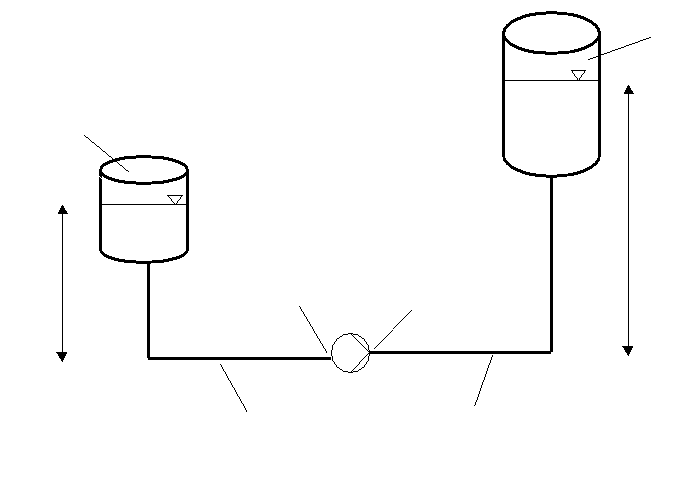
Calculation workflow
- Characterise the pumped medium: For the pumped medium, the vapour pressure at operating temperature, the density and the dynamic viscosity are defined – the vapour pressure is the critical quantity for the cavitation assessment and rises steeply with temperature.
- Record system geometry and pressures: The geodetic height difference between the liquid level and the pump inlet, the barometric pressure or system pressure on the suction vessel, and the geometric data of the piping (diameters, lengths, fittings) form the system side of the calculation.
- Calculate pressure losses and system curve: From the volume flow, pipe geometry and fluid properties, the friction losses of the lines are determined; together with the geodetic head, this yields the system characteristic curve as a function of the volume flow.
- Determine the NPSH value of the system: The available NPSH value follows from the absolute pressure on the suction-side liquid level minus the vapour pressure head, corrected for the geodetic suction lift or positive suction head and reduced by the head loss of the suction line.
- Check operating point and cavitation safety: Pump and system curves are superimposed; at the operating point, the available NPSH is compared with the pump's required NPSH. A safety margin of at least 0.5 m is customary; otherwise the suction head, piping layout, speed or pump type must be adjusted.
Input quantities
| Quantity | Symbol | Unit |
|---|---|---|
| Vapour pressure | Dampfdruck | Pa |
| Density | Dichte | kg/m³ |
| Reservoir overpressure | Sytem-Überdruck | Pa |
| Velocity of supply in the reservoir | Zulaufgeschwindigkeit | m/s |
| Supply height +/- | Zulaufhöhe | m |
| Geodesic level | Geod.Höhe | m |
| Barom. pressure | Druck | Pa |
| Pump description | Pumpen-Bezeichnung | - |
| Fluid | Fördermedium | - |
| Reservoir overpressure | Druckseite | Pa |
| Outlet height +/- | Ablaufhöhe | m |
| Vol. flow rate | Volumenstrom | m³/s |
| Dyn. viscosity | Viskosität | mPa·s |
| Inside diameter | Rohrleitung | m |
| Wall roughness | Rohrleitung | m |
| Length | Rohrleitung | m |
| Inside diameter | Rohrleitung | m |
| Wall roughness | Rohrleitung | m |
| Length | Rohrleitung | m |
| Fittings: Zeta | (Saugseite) | - |
| Fittings: Zeta | (Druckseite) | - |
| Linie) | Linie) | m³/s |
| Linie) | Linie) | m³/s |
| Linie) | Linie) | m³/s |
Calculated results
| Quantity | Symbol | Unit |
|---|---|---|
| Pressure drop in the pipe | Rohrleitung | Pa |
| NPSH required | NPSH | m |
| NPSH actual | NPSH | m |
| Pressure drop in the pipe | Druckverlust | Pa |
| Geod. pres. diff. | Saugseite | Pa |
| Geod. pres. diff. | Druckseite | Pa |
| Suction side (abs) | Saugseite | Pa |
| Pressure side (abs) | Druckseite | Pa |
| Pressure difference | Differenzdruck | Pa |
| Head | Pumpe | m |
| Performance pump | Pumpe | W |
| Velocity | Rohrleitung | m/s |
| Friction factor | Rohrreibungsbeiwert | - |
| Reynolds Number | Reynoldszahl | - |
| Velocity | Rohrleitung | m/s |
| Friction factor | Rohrreibungsbeiwert | - |
| Reynolds Number | Reynoldszahl | - |
| Efficiency pump | Pumpe | % |
Worked example
A centrifugal pump draws water at 20 °C from an open vessel. The water level is 2.0 m below the pump inlet (suction lift operation). The head loss of the suction line at the operating flow rate is 0.8 m. What is the available NPSH value, and is it sufficient for a pump with NPSHr = 4.0 m? A worked example of an NPSH calculation for a centrifugal pump.
Given values
| Barometric pressure pb | 1.013 bar (101,325 Pa) |
| Vapour pressure of water at 20 °C pv | 2,340 Pa |
| Density ρ | 998 kg/m³ |
| Geodetic suction lift zs | 2.0 m (level below pump) |
| Suction line head loss Hv | 0.8 m |
| NPSH required (pump) | 4.0 m |
Solution
Pressure head from vessel pressure and vapour pressure
(pb − pv)/(ρ · g) = (101,325 − 2,340)/(998 · 9.81) = 98,985/9,790 = 10.11 m
Available NPSH value
NPSHa = (pb − pv)/(ρ·g) − zs − Hv = 10.11 − 2.0 − 0.8 = 7.31 m
(The velocity head at the inlet is already included in the NPSH definition as total pressure.)
Comparison with the pump requirement
NPSHa − NPSHr = 7.31 − 4.0 = 3.31 m margin.
The customary minimum margin of 0.5 m is met by a wide margin — the pump operates safely without cavitation. With hotter water, the margin shrinks quickly: at 80 °C (pv ≈ 0.474 bar, ρ ≈ 972 kg/m³) only about NPSHa ≈ 2.9 m would remain, and the pump would cavitate.
Result
| NPSH available | 7.31 m |
| NPSH required | 4.00 m |
| Cavitation margin | 3.31 m — operation safe |
All values are illustrative. The applicable standard and project-specific boundary conditions remain authoritative.
Frequently asked questions
What is the difference between available NPSH and required NPSH?
Available NPSH (NPSHa) is a system quantity: the margin of the total pressure at the pump inlet above the vapour pressure, expressed as a head. Required NPSH (NPSHr) is a pump property from the manufacturer's test: the value at which the head has dropped by 3 % due to cavitation. Cavitation-free operation requires NPSHa > NPSHr plus a safety margin.
Why is pumping boiling media so critical?
For a boiling medium, the vessel pressure equals the vapour pressure – the pressure term in NPSHa vanishes completely. All that remains is the geodetic positive suction head minus the suction line losses. Condensate and boiler feed pumps therefore imperatively need flooded suction (vessel above pump), and the suction line must be short and low-resistance.
What role does the barometric pressure play?
For open vessels, atmospheric pressure provides the driving absolute pressure on the suction-side level – roughly 10 m of water column at sea level. It decreases with installation altitude by about 0.12 bar per 1,000 m; a pump that draws safely at sea level may already cavitate in the highlands. The local atmospheric pressure is therefore one of the input data.
Does a larger suction line help against cavitation?
Yes, this is often the most effective measure: the head loss of the suction line is deducted directly from NPSHa and decreases roughly with the fourth to fifth power of the diameter. Short pipe runs, long-radius bends, full-bore valves and avoiding unnecessary fittings on the suction side also help.