Engineering task and calculation objective
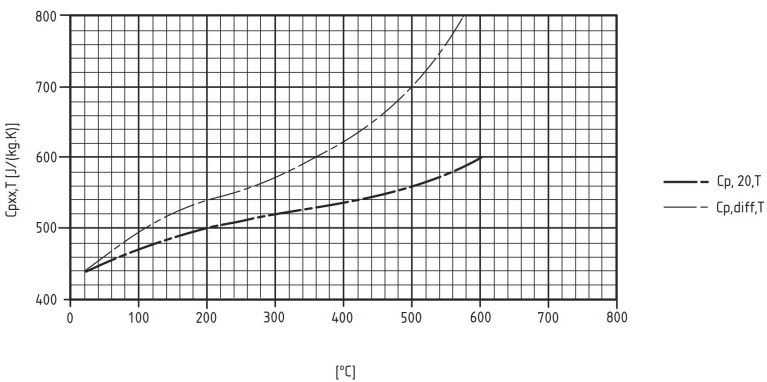
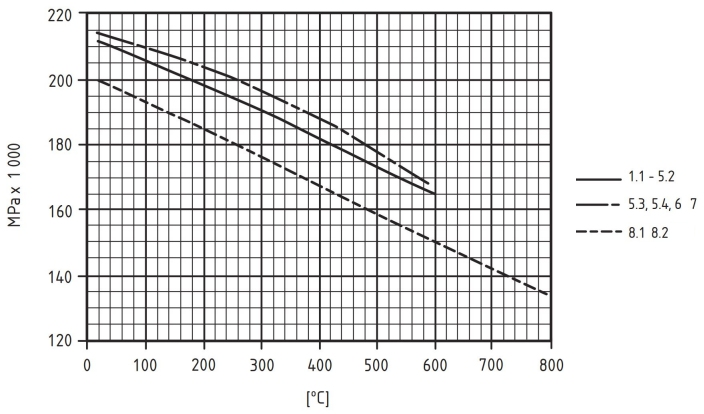
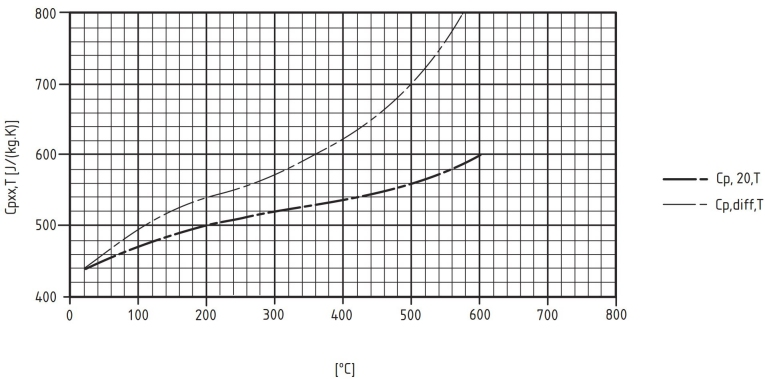
The ENAO module determines physical properties of steels to DIN EN 13445-3 Annex O. For the steel groups commonly used in pressure vessel construction, from unalloyed and low-alloy ferritic steels to austenitic stainless steels, it calculates the modulus of elasticity, linear coefficient of thermal expansion, thermal conductivity, specific heat capacity and density at any temperature. Annex O works with relationships between the differential properties and the respective property at reference temperature (20 °C); in addition, the values are represented by polynomial expressions in temperature.
These material property values are needed in almost every downstream calculation: the modulus of elasticity at design temperature enters stability and buckling checks as well as flange and tubesheet calculations, the coefficient of thermal expansion enters the determination of thermal restraint forces, for instance in fixed tubesheet heat exchangers, and thermal conductivity, heat capacity and density enter transient temperature field calculations for fatigue assessments to clauses 17 and 18. If you want to calculate temperature-dependent steel properties, Annex O provides a consistent data basis conforming to the standard, without having to interpolate individual values from scattered material standards.
Note that Annex O provides typical properties per steel group; strength values such as yield strength and creep rupture values still come from the material standards of the EN 10028 series and the harmonized material data sheets.
Standard and calculation basis: DIN EN 13445-3, Anhang O
Calculation workflow
- Assign the steel group: The material under consideration is assigned to one of the steel groups covered by Annex O, for example unalloyed and creep-resistant ferritic steels, high-alloy martensitic steels, or austenitic stainless steels. The group assignment determines the coefficients to be applied.
- Establish the reference values: The starting point is the properties at reference temperature, in particular the density at 20 °C. The temperature-dependent curves are described relative to these reference values, which ensures transferability within a steel group.
- Calculate the property at the target temperature: For the desired temperature, the modulus of elasticity, differential and mean coefficient of thermal expansion, thermal conductivity, specific heat capacity and density are evaluated. The module calculates the values both via the relationships of the differential properties and via the polynomial representation and compares the two.
- Distinguish between the expansion coefficients: For strain calculations between two temperatures, the mean expansion coefficient over the temperature interval governs; for local derivatives (for instance in thermal stress formulas), the differential value at the target temperature applies. The module reports both quantities separately.
- Carry the values into downstream calculations: The property values obtained feed into downstream calculations as input data: the modulus of elasticity into buckling and flange checks, the expansion coefficients into restraint force and thermal stress calculations, and thermal conductivity, heat capacity and density into temperature field and fatigue analyses.
Input quantities
| Quantity | Symbol | Unit |
|---|---|---|
| Averaged temperature | T* | °C |
| Starting temperature | T1 | °C |
| End temperature | T2 | °C |
| Reference temperature | T0 | °C |
| Temperature | T | °C |
| Temperature difference | ∆T | °C |
| Steel group | Stahl | – |
| Linear thermal expansion Diff. Eq. | βdiff,T* | 1E-6/K |
| Differential thermal expansion Diff. Eq. | βdiff,T | 1E-6/K |
| Differential thermal expansion Polynomial | βdiff,T | 1E-6/K |
| Thermal expansion from 20°C to T | β20,T | 1E-6/K |
| Differential quotient of thermal expansion at temperature T | ∂β20,T/∂T | 1/K^2 |
| Linear coefficient of thermal expansion from 20°C to T | β20,T | 1/K |
| Density at temperature T | ρT | kg/m³ |
| Density at 20°C | ρ20 | kg/m³ |
| Length of a specimen at temperature T | lT | m |
| Length of a specimen at 20°C | l20 | m |
| Differential specific thermal capacity Diff. Eq. | cp,diff,T | J/(kg·K) |
| Differential specific thermal capacity Polynomial | cp,diff,T | J/(kg·K) |
| Specific thermal capacity from 20°C to T | cp,20,T | J/(kg·K) |
| Differential quotient of specific thermal capacity at T | ∂cp,20,T/∂T | J/(kg*K^2) |
| Thermal diffusivity | Dth | m²/s |
| Linear thermal expansion Polynomial | βdiff,T* | 1E-6/K |
| Poisson's ratio | ν | - |
Calculation options
Steel group
1 · 2 · 3 · 4 · 5 · 6 · 7 · 8 · 9 · 10 · 11 · 12
Frequently asked questions
What is the difference between the differential and the mean coefficient of thermal expansion?
The differential coefficient describes the slope of the strain-temperature curve at a specific temperature, the mean coefficient the total strain referred to a temperature interval, usually from 20 °C to the target temperature. For the change in length of a component between two temperatures, the mean value must be used; formulas for local thermal stresses, by contrast, usually contain the differential value. Confusing the two is a classic source of error in restraint force calculations.
Does Annex O apply to every specific steel or only to steel groups?
Annex O describes the typical behaviour of frequently used steel groups; within a group, the real values of individual heats scatter only slightly, because the physical properties are less sensitive to alloying than the strength values. For standard verifications, the group-based treatment is sufficiently accurate. For special materials, nickel-base alloys or non-ferrous metals, the manufacturer's data or dedicated material data sheets must be used.
Why do the property values of ferritic and austenitic steels differ so markedly?
Austenitic steels have a face-centred cubic lattice: they expand considerably more on heating than ferritic steels and conduct heat much less well. Together, both effects lead to higher thermal stresses in austenitic components during temperature transients. The modulus of elasticity of austenitics is also somewhat lower. In mixed construction, for instance clad plates or dissimilar (black-white) welds, these differences cause additional restraint stresses at the material interface.
Can I also determine strength values such as the yield strength with Annex O?
No. Annex O provides exclusively physical properties: modulus of elasticity, thermal expansion, thermal conductivity, heat capacity and density. Temperature-dependent strength values such as proof strength, tensile strength or creep rupture strength must be taken from the material standards (e.g. EN 10028) and enter the verifications via the nominal design stress to EN 13445-3 clause 6.