Engineering task and calculation objective
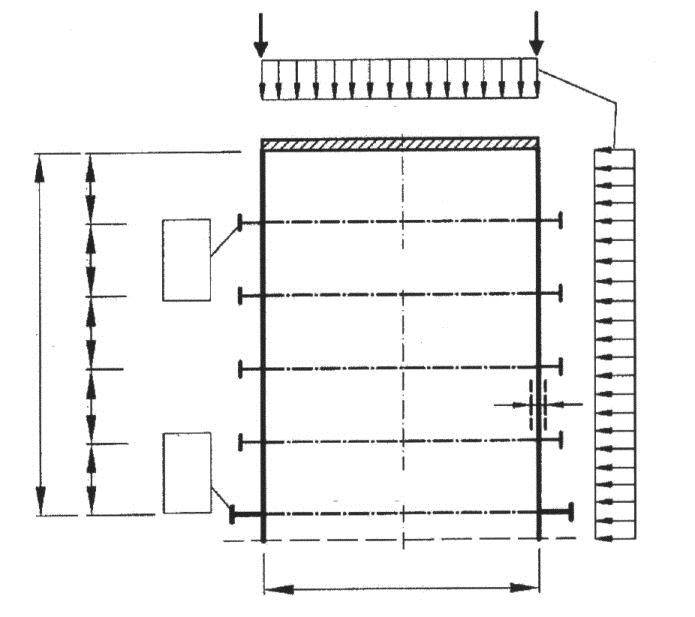
The EC3Stiff module verifies ring-stiffened cylindrical shells to DIN EN 1993-1-6 (Eurocode 3) and thereby extends the cylinder calculation of the EC3Cyl module. Ring stiffeners made of flat steel divide the shell into shorter buckling panels and thus considerably increase the buckling resistance against external pressure and wind – an economical alternative to increasing the wall thickness throughout for silos, tanks and chimneys. Internal and external stiffeners are supported in three functional types: light ring stiffener, heavy intermediate ring stiffener and heavy end ring stiffener.
The verification covers more than stiffness alone: the ring stiffener itself can fail by flexural buckling or by tilting about its attachment line. The module therefore checks, among other things, the existing initial tilt of the ring stiffener against the allowable initial tilt parameter and performs the check with its own partial safety factor against flexural buckling. Material properties such as yield strength, modulus of elasticity, shear modulus and Poisson's ratio can be entered separately for the shell and the ring stiffener.
This makes it possible to calculate ring-stiffened cylindrical shells as they are state of the art in silo construction per DIN EN 1993-4-1 and in tank construction – including the case distinctions for the different stiffener types and mounting positions.
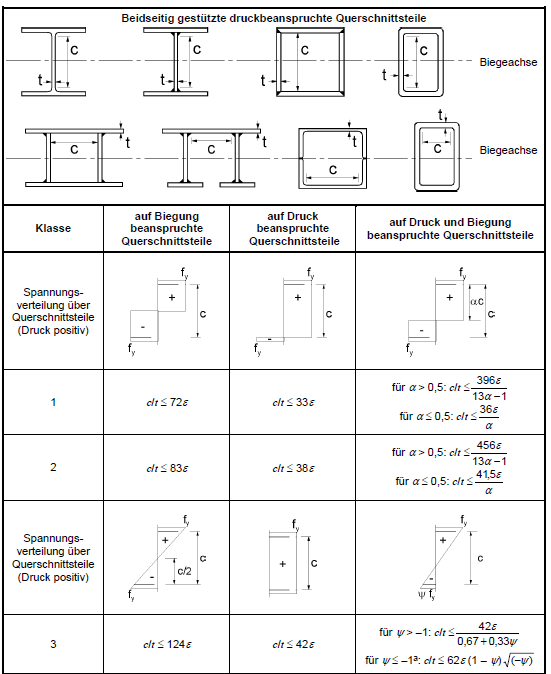
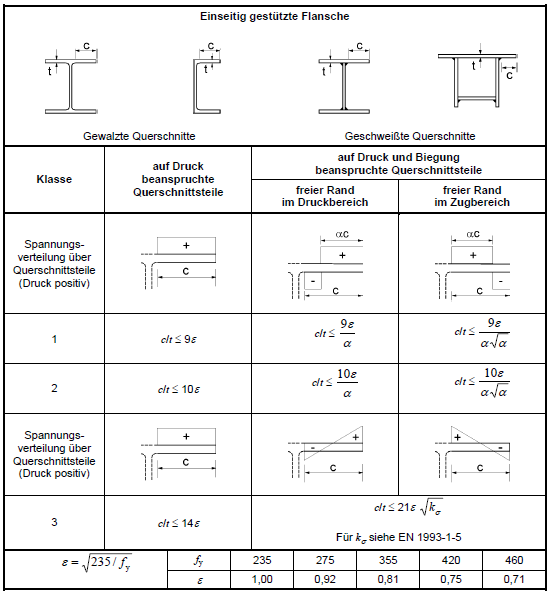
Standard and calculation basis: DIN EN 1993-1-6: 2017-07 (Eurocode 3)
Calculation workflow
- Select stiffener type and mounting position: First, the function of the ring stiffener is defined: light ring stiffener, heavy intermediate ring stiffener or heavy end ring stiffener, each mounted internally or externally. This case distinction controls which requirements on stiffness and load-bearing capacity apply.
- Record materials and properties separately: For the cylindrical shell and the ring stiffener, the material, yield strength and modulus of elasticity are entered, and for the stiffener additionally the shear modulus and Poisson's ratio; from these follows the design value of the yield strength with the associated partial safety factors.
- Determine buckling panels and effective shell width: The ring stiffeners divide the cylinder into buckling panels whose length enters the shell buckling checks per EN 1993-1-6. For the stiffener cross-sections, the effective width of the adjacent shell is taken into account, producing an effective ring cross-section.
- Verify the load-bearing capacity of the ring stiffener: The stiffener is verified for the circumferential compressive force resulting from external pressure, wind and, where applicable, bulk solids loads: cross-section resistance and stability against flexural buckling in the ring plane and tilting out of the plane, using the partial safety factor against flexural buckling of the ring stiffener.
- Check the initial tilt: The existing initial tilt of the ring stiffener (a fabrication imperfection) is compared with the allowable initial tilt parameter. The assumed resistances are valid only if the tolerance is met; the check is reported explicitly in the module.
Input quantities
| Quantity | Symbol | Unit |
|---|---|---|
| Type of ring stiffener | Rst | – |
| Outside diameter of shell | dac | m |
| Wall thickness of cylindrical shell | tc | mm |
| Length of ring-stiffened cylindrical shell | lc | mm |
| Length of unstiffened shell between the centroids of light stiffeners | lr | mm |
| Shared cylinder length of a heavy stiffener | lhb | mm |
| Number of light ring stiffeners | nr | – |
| Shape of cross-section of ring stiffeners | csr | – |
| Show equations | anzeigen | – |
| Flat stiffener external or internal | Plsit | – |
| Fabrication method of ring stiffeners | Hrst | – |
| Width of stiffener flange | bf | mm |
| Thickness of stiffener flange | tf | mm |
| Width of stiffener web | bw | mm |
| Thickness of stiffener web | tw | mm |
| Width of flat steel ring stiffener cross section | br | mm |
| Thickness of flat steel ring stiffener cross section | tr | mm |
| Cross-sectional area of ring stiffener | Ar | mm² |
| Moment of inertia y ring stiffener | Jrypr | mm^4 |
| Moment of inertia z ring stiffener | Jrzpr | mm^4 |
| 2nd torsional moment of inertia | Jrt | mm^4 |
| Outward eccentricity of the centroid of a stiffener from the shell middle surface | Z0 | mm |
| Case distinction | 17.2 | – |
| Existing out-of-roundness of ring stiffeners | a | mm |
Calculated results
| Quantity | Symbol | Unit |
|---|---|---|
| Radius of cylinder middle surface | rc | mm |
| Ratio wall thickness and radius of cylindrical shell | r/t | – |
| Shared cylinder length of stiffeners | lr/h | mm |
| Condition | nrx | – |
| Inter-stiffener buckling reduction factor circumferential load, EC3 cylindrical wall | Χθloc | – |
| Width of stiffener flange abutting against the wall | b0 | mm |
| Cross-sectional area of ring stiffener | Arst | mm² |
| Moment of inertia y ring stiffener | Jry | mm^4 |
| Moment of inertia z ring stiffener | Jrz | mm^4 |
| Radius of the centroid of a stiffener | r0rr | mm |
| Parameter | η1 | – |
| effective width of cylinder wall for circumferential force | beN | mm |
| corrected width I, T, L profile | b | mm |
| Width of ring stiffener | bges | mm |
| Outward eccentricity of the centroid of a stiffener from the shell middle surface | Z0rst | mm |
| Effective cross-sectional area of ring stiffener | Arehe | mm² |
| Effective outward eccentricity of the centroid of a stiffener from the mid-shell surface | Z0re | mm |
| Outward positive distance of a stiffener centroid of the effective cross section | e0 | mm |
| Outward positive distance of a stiffener extreme surface from the centroid of the effective cross section | eR | mm |
| Inward positive distance of the shell middle surface from the centroid of the effective cross section | eU | mm |
| Auxiliary value | ωr | – |
| Condition | 17.1 | – |
| Condition | 17.1 | – |
| Parameter m=2 | C12 | – |
Calculation options
Type of ring stiffener
light ring stiffener · heavy ring stiffener · end closure
Shape of cross-section of ring stiffeners
flat-rolled steel · L profile · T profile · H profile
Flat stiffener external or internal
external flat stiffener · internal flat stiffener
Fabrication method of ring stiffeners
cold-formed · hot-rolled welded
Case distinction
excellent · high · normal
Case distinction
excellent · high · normal
≈ same yield strength of cylinder - ring stiffener
almost the same yield strength · not the same yield strength
Fabrication method H profile EN 1993-1-1 Table 6.4
rolled profile · welded profile
Frequently asked questions
What distinguishes light and heavy ring stiffeners?
Light ring stiffeners act primarily as boundaries of the buckling panels: they must be stiff enough to act as a nodal line of the buckling pattern but carry only small loads themselves. Heavy intermediate and end ring stiffeners additionally carry circumferential forces by design, for example from redistribution of wind pressure or as edge stiffening at the shell end, and must satisfy cross-section and stability checks for this. The requirements on the second moment of area and the cross-sectional area are correspondingly higher.
Why must the initial tilt of the ring stiffener be verified?
A flat steel stiffener that does not stand exactly perpendicular to the shell carries load eccentrically and, under circumferential compression, tends to tilt or fail by lateral-torsional buckling much earlier. The resistances assumed in the verification are valid only if the actual initial tilt lies within the allowable initial tilt parameter. This value is a fabrication tolerance that must be checked on site or in the workshop.
Internal or external ring stiffeners – what should be considered?
Structurally, both arrangements are possible; the mounting position influences the eccentricity of the effective ring cross-section relative to the shell mid-surface and thus the stress distribution. In practice, for silos, product flow and abrasion usually favour external stiffeners, while internal stiffeners keep the outer contour clear (insulation, appearance). Corrosion protection and accessibility for inspection are further selection criteria.
Does the ring stiffening replace the buckling check of the shell?
No. The stiffeners shorten the buckling panel length and thus increase the critical external pressure of the shell panels, but the buckling check of the cylindrical shell to EN 1993-1-6 (module EC3Cyl) must still be performed for each panel between the stiffeners. Only the combination of panel check and stiffener check yields the complete stability verification of the ring-stiffened shell.