Engineering task and calculation objective
The MESK module provides the thermophysical properties of a coolant: density, specific heat capacity, dynamic viscosity, thermal conductivity and the Prandtl number derived from them, in each case taking the phase state into account. These quantities are the input data for practically every thermal calculation – without consistent fluid properties, neither heat transfer coefficients nor pressure drops can be determined reliably.
In practice, the module is used as a fluid-property building block within larger calculations, for example in the design of cooling circuits, cooling jackets or heat exchangers: anyone who wants to calculate the heat transfer of a coolant needs the Prandtl number and thermal conductivity for the Nusselt correlation, plus density and viscosity for the Reynolds number and the pressure drop. The properties are evaluated at the relevant operating state, so that the temperature dependence of the fluid properties correctly enters the downstream calculations.

Calculation workflow
- Define coolant and phase state: First, the phase state of the coolant is determined, because property correlations are always valid for one phase only; liquid and vapour/gas differ in density and viscosity by orders of magnitude.
- Evaluate properties at the operating state: For the specified state, density, specific heat capacity, dynamic viscosity and thermal conductivity of the coolant are calculated from the stored correlations.
- Form derived characteristic numbers: From viscosity, heat capacity and thermal conductivity, the Prandtl number Pr = η·cp/λ is formed – the key fluid-property number for all heat transfer correlations.
- Pass the values to the main calculation: The fluid properties feed into downstream modules, for example to calculate the Reynolds and Nusselt numbers, the heat transfer coefficient and the pressure drop of the cooling circuit.
Input quantities
| Quantity | Symbol | Unit |
|---|---|---|
| Show Condenser Overview | – | – |
| Show Tubesheet Overview | – | – |
| Choose Options | – | – |
| Type of tubesheet | – | – |
| Variable 12 | – | – |
| Variable 13 | Ḋin | – |
| Variable 14 | pD,in | – |
| Variable 15 | pGuess | – |
| Variable 16 | TD,in | – |
| Variable 17 | – | – |
| Variable 18 | K̇F,in | – |
| State of phase | – | – |
| Variable 20 | ṀCM | – |
| Variable 21 | pCM,in | – |
| Variable 22 | TCM,in | – |
| Coolant | – | – |
| Specific Heat Capacity Coolant | cp,KM | – |
| Dyn. Viscosity Coolant | ηKM | – |
| Prandtl Coolant | PrKM | – |
| Heat Conductivity Coolant | λKM | – |
| Outside diameter tubes | da | – |
| Inside diameter tubes | di | – |
| Tube pitch (transverse) | s1 | – |
| Tube pitch (longitudinal) | s2 | – |
Calculated results
| Quantity | Symbol | Unit |
|---|---|---|
| Area of condensing | Akond | – |
| Pressure loss | ΔpD | – |
| Velocity Inlet | vD,ein | – |
| Velocity Outlet | vD,aus | – |
| Velocity in 1. baffle window | vD,Bl1 | – |
| Pressure loss | ΔpKM | – |
| Velocity | vKM | – |
| Reynolds Number | ReKM | – |
| Heat transfer coefficient | αKM | – |
| Variable 69 | – | – |
| Variable 70 | – | – |
| Variable 71 | – | – |
| Variable 72 | – | – |
| Variable 73 | – | – |
| Variable 74 | – | – |
| Variable 75 | – | – |
| Variable 76 | – | – |
| Variable 77 | – | – |
| Variable 78 | – | – |
| Variable 79 | – | – |
| Variable 80 | – | – |
| Variable 81 | – | – |
| Variable 82 | – | – |
| Variable 83 | – | – |
Calculation options
Choose Options
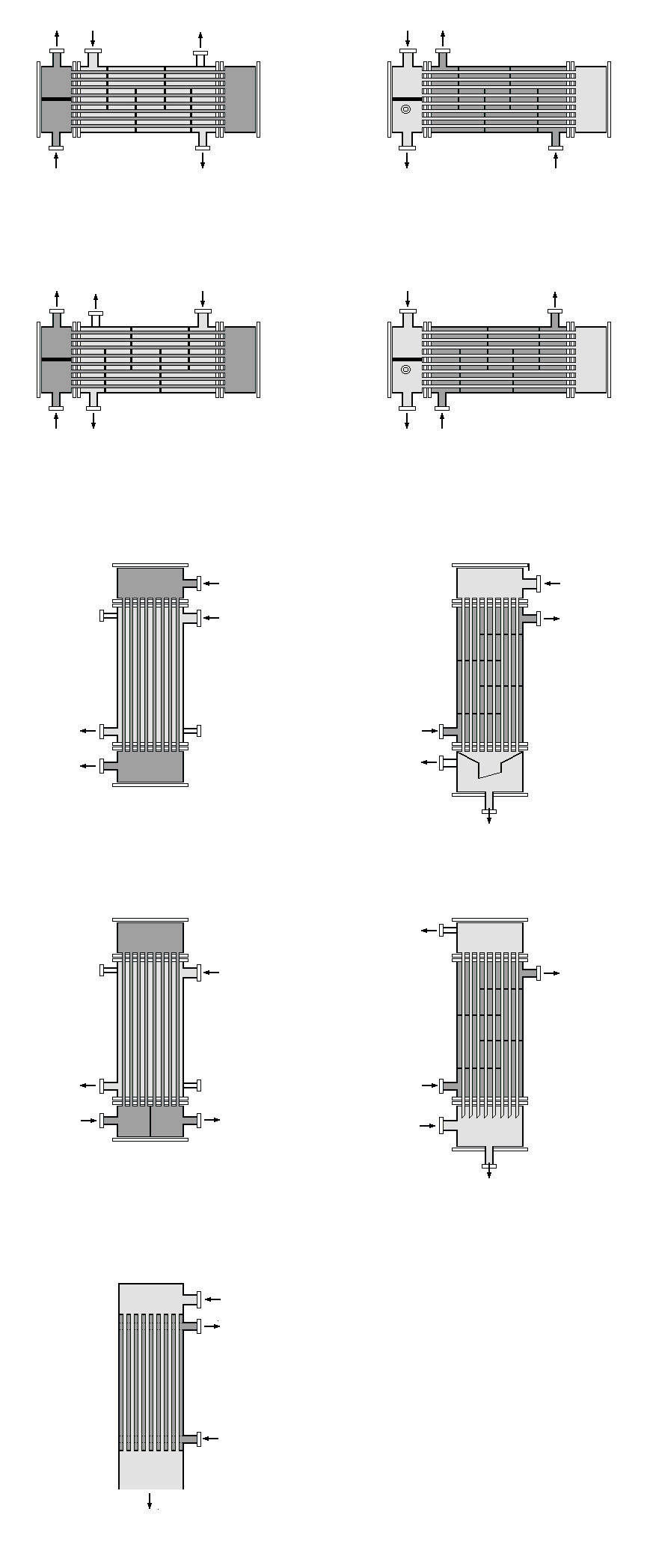
Type 100 shell-side condenser · Type 100 shell-side condenser · Type 200 tube-side condenser · Type 200 tube-side condenser "reverse" · Type 300 shell-side condenser · Type 320 "reverse" · Type 400 tube-side condenser · Type 500 tube-side condenser · Type 1000 sheet-stack condenser
Type of tubesheet
Single pass (Typ 0) · Double pass (Typ 1) · Four passes (one above the other, Typ 2)
Variable 17
No · Yes
State of phase
gaseous · liquid
Coolant
Water H2O · Ammonia NH3 · Nitrogen N2 · Refrigerant 22 CHCLF2 · Refrigerant 134a C2H2F2 · Refrigerant 152a C2H2F2 · ATLAS "T-Oil" · Property server · Own Values
Central pipe?
No · Yes
Variable 217
Circular fins · Fin plate
Coolant side
Vertically upwards · Vertically downwards · Horizontally from left · Horizontally from right
Frequently asked questions
At which temperature should the properties be evaluated?
It is common practice to evaluate at the mean fluid temperature of the section under consideration. For large temperature differences between wall and fluid, many Nusselt correlations additionally require a correction factor using the viscosity or Prandtl number at wall temperature – in that case, the properties may need to be evaluated twice.
Why is the Prandtl number so important for coolant selection?
The Prandtl number describes the ratio of momentum to heat transport. Water (Pr ≈ 2–7) and water-based mixtures transfer heat far better at the same flow conditions than highly viscous oils (Pr up into the thousands); for gases, Pr is around 0.7. Via the Nusselt correlation, Pr directly enters the achievable heat transfer coefficient.
What should be considered for coolant mixtures such as water-glycol?
Additives change all properties at once: glycol, for example, lowers the thermal conductivity and heat capacity and increases the viscosity considerably, especially at low temperatures. An antifreeze mixture therefore needs a higher circulation rate for the same cooling duty and delivers poorer heat transfer than pure water – the properties must be evaluated for the actual concentration.